
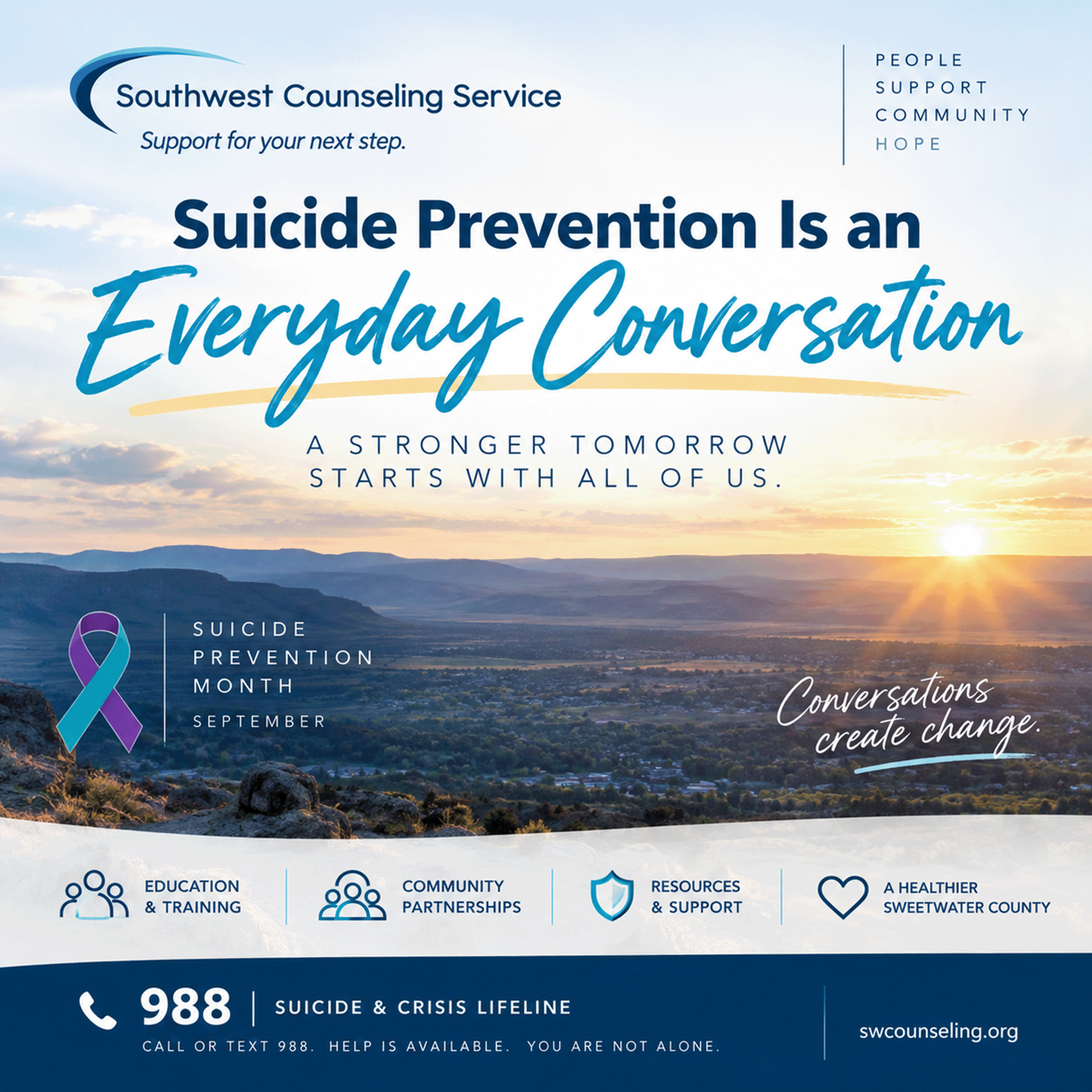
At Southwest Counseling Service, Suicide Prevention is an Everyday Conversation
SCS prevention specialists connect state resources, local partners, and behavioral health expertise to prevention efforts throughout Sweetwater County
September is Suicide Prevention Month, but for Southwest Counseling Service Prevention Specialist Jayda Gatley, the conversation doesn’t begin when the calendar turns to September.
“There’s probably not a single day that I come to work that I don’t have a conversation about suicide,” Gatley said.
Based at Southwest Counseling Service, Gatley works throughout Sweetwater County to connect schools, businesses, community organizations, and residents with education, training, and resources intended to prevent suicide and substance misuse before they result in crisis.
The work is part of Wyoming’s Community Prevention Grant program, administered through the Wyoming Department of Health. Sweetwater County receives the grant and partners with Southwest Counseling Service to implement prevention strategies locally. SCS employs the county’s prevention specialists, who also lead the Sweetwater County Prevention Coalition and work hand in hand with its network of community partners.
“Having prevention and treatment under the same roof creates a natural bridge between the two,” SCS Executive Director John Grossnickle said. “It allows us to collaborate closely, reach people who may be at higher risk, and connect them with the right resources more effectively.”
Prevention beyond September
Prevention staff distribute 988 Suicide & Crisis Lifeline materials, provide resources to local schools, and work with community organizations interested in suicide-prevention education. SCS prevention specialists also provide QPR and PROSPER suicide-prevention trainings at no cost to participating community organizations and businesses.
This month, prevention staff have provided resources to local junior high and high school students and are preparing to support additional school-based suicide-awareness efforts. Gatley is also completing specialized suicide postvention training and taking suicide-awareness education directly into a local industrial workplace.
Reaching working adults is particularly important in Sweetwater County, Gatley said. Working-age men, particularly middle-aged and older working men, remain an important population for local prevention efforts.
While communities are often willing to discuss suicide prevention among young people, Gatley said conversations about suicide among adults can be more difficult to begin.
“If youth suicide prevention is a conversation people want to have, I’m willing to have that conversation,” Gatley said. “Hopefully, it’s a first step toward talking about adult suicide prevention, too. That’s a conversation we definitely need to have, especially with middle-aged men.”
For prevention staff, taking education directly into workplaces, schools, and community organizations provides opportunities to reach people who may never otherwise seek out suicide-prevention information or formal training.
Prevention is a community effort
The Sweetwater County Prevention Coalition brings together local organizations and community stakeholders to identify prevention needs and implement strategies. The coalition meets monthly and works with prevention specialists on priorities that include suicide as well as underage alcohol and marijuana use, adult alcohol overconsumption, opioid and stimulant misuse, and tobacco and nicotine use.
The work can be as visible as a community awareness campaign or as simple as putting a resource into someone’s hands.
Southwest Counseling Service’s prevention program provides free medication lockboxes and gun locks to community members and offers suicide-prevention training to interested organizations. Residents interested in resources or businesses and organizations interested in hosting a prevention training can contact Southwest Counseling Service and ask to speak with Prevention.
“Prevention gives us an opportunity to reach people earlier, before distress becomes a crisis,” SCS Clinical Director Elisa Robbins said. “The more comfortable people become recognizing warning signs, asking difficult questions, and connecting someone with help, the more opportunities we have to intervene.”
For someone experiencing a mental health or suicide crisis, reaching crisis does not mean suicide is the only option, Gatley said.
“There are resources, and there is help,” she said. “There are other options.”
Anyone experiencing suicidal thoughts or a mental health crisis can call or text the 988 Suicide & Crisis Lifeline at 988. For appointments or more information about Southwest Counseling Service, call (307) 352-6680 or (307) 352-6677. In an emergency, call 911.